Most pay discussions assume you work the whole month. Real working life is rarely that tidy: you start a new job on the 14th, hand in your notice and leave on the 20th, or take a week of unpaid leave in March. Whenever you are only paid for part of a calendar month, your salary needs to be worked out pro rata for that month — and a pro rata salary calculator for partial month pay does the arithmetic in seconds.
The quick answer: to calculate pro rata pay for a partial month, take your normal monthly salary, divide it by the number of days in that month, and multiply by the number of days you worked (or are being paid for). For example, a £2,500 monthly salary with 15 paid days in a 30-day month gives £2,500 × (15 ÷ 30) = £1,250. This is the calendar-day method most UK payroll teams use; a working-day variant exists and can give a slightly different figure, as explained below.
This guide covers both methods UK employers use, shows worked examples for joining mid-month, leaving mid-month and unpaid leave, and explains how to check the figure on your payslip — so the partial month never short-changes you.
When a Partial Month Comes Up
A partial month is simply any calendar month in which you are paid for only some of the days. The common triggers are:
- Joining mid-month: your first day is the 9th, the 16th, or the 23rd — your first payslip covers only the remaining days.
- Leaving mid-month: your last working day falls before month-end, so your final pay covers only the days up to your leaving date.
- Unpaid leave or unpaid absence: a week of unpaid leave in an otherwise full month is deducted day by day.
- Changing hours mid-month: moving from full-time to part-time (or the reverse) partway through the month means the month is split into two rates.
- Suspension or garden leave on reduced pay: some contracts allow partial pay for part of a month.
In every case the question is the same: what fraction of a full month’s pay are you owed? A pro rata salary calculator for partial month scenarios answers it without the mental gymnastics.
The Two Methods UK Payroll Uses
There is no single statutory formula for partial-month pay in the UK, so employers use one of two accepted approaches. Knowing which one your employer uses matters, because they can produce different answers — sometimes by £40 or £50 on a typical salary.
Method 1: The Calendar-Day Method
This is the most common approach. Your monthly salary is spread across every calendar day in the month, including weekends:
Partial-month pay = Monthly salary × (days you are paid for ÷ total days in the month)
Your monthly salary is your annual salary divided by 12. If you earn £30,000 a year, your monthly salary is £2,500. Work 15 days of a 30-day month and you get £2,500 × (15 ÷ 30) = £1,250.
The catch: months have different lengths. Ten paid days in February (28 days) are worth more than ten paid days in March (31 days):
| Month | Monthly salary | Paid days | Calendar-day result |
|---|---|---|---|
| February (28 days) | £2,500 | 10 | £892.86 |
| March (31 days) | £2,500 | 10 | £806.45 |
| April (30 days) | £2,500 | 10 | £833.33 |
That £86 gap between February and March is entirely down to month length — the same ten days of work. Nothing is “wrong” with either figure; it is just how the payroll calendar works.
Method 2: The Working-Day Method
Some employers — particularly for salaried staff on a five-day week — spread the annual salary across working days only, typically 260 working days a year (52 weeks × 5 days):
Partial-month pay = (Annual salary ÷ 260) × working days you are paid for
On £30,000 a year, one working day is worth £115.38. Work 11 working days in your partial month and you get £1,269.23, regardless of whether the month is February or August. Bank holidays are usually counted as paid working days under this method, so check whether your employer includes them in the count.
Worked Example: Joining on the 15th
Priya is offered a full-time role on £36,000 a year. Her monthly salary is £3,000 and she starts work on 15 March. March has 31 days, and counting from the 15th to the 31st inclusive gives 17 paid days.
Calendar-day method: £3,000 × (17 ÷ 31) = £1,645.16
Working-day method: £36,000 ÷ 260 = £138.46 per working day. Between 15 and 31 March 2026 there are 13 weekdays (assuming no bank holiday), so £138.46 × 13 = £1,800.00.
That is a £155 difference for the same start date, purely from the method. Neither is illegal — but your contract or staff handbook may specify one. If it does not, ask payroll which they use before your first payday so there are no surprises.
A Part-Time Version
Now suppose Priya works 3 days a week (0.6 of a 5-day full-time week) on the same £36,000 FTE salary. Her full-time monthly salary of £3,000 is first pro-rated for part-time hours: £3,000 × 0.6 = £1,800 a month. Then the partial month applies on top:
Calendar-day method: £1,800 × (17 ÷ 31) = £987.10
The two layers of pro-rating — first for hours, then for the partial month — multiply together. This is exactly the kind of double calculation where a pro rata salary calculator for partial month pay earns its keep.
Deducting Unpaid Leave from a Full Month
Unpaid leave works as the mirror image: start from the full monthly salary and subtract one day’s pay for each unpaid day. The daily rate depends on the method:
- Calendar-day daily rate: monthly salary ÷ days in the month. On £2,500 in a 30-day month, each day is worth £83.33 — including weekends, so five unpaid weekdays cost 5 × £83.33 = £416.67.
- Working-day daily rate: annual salary ÷ 260. On £30,000, each working day is £115.38, and five unpaid weekdays cost £576.92.
Notice the calendar-day method charges you less for unpaid weekdays in a 30-day month, but it also “charges” you for weekends you would never have worked. Neither method is universally fairer — which is why the method should be written down in your contract or leave policy.
Changing Hours Mid-Month
If you move from full-time to part-time on, say, the 16th of a 30-day month, payroll splits the month into two slices:
- Days 1–15 at the full-time monthly rate: £3,000 × (15 ÷ 30) = £1,500 (calendar-day method).
- Days 16–30 at the new part-time monthly rate: £1,800 × (15 ÷ 30) = £900.
- Total for the month: £1,500 + £900 = £2,400.
The same split logic applies if your salary changes mid-month after a pay rise — each slice is calculated at its own rate.
Partial Month vs the Full-Period Day-Count Method
You may also see a third approach, especially for fixed-term contracts: the annual day-count method, where pay = annual salary × (days in the period ÷ 365). For a 17-day slice of a £36,000 salary that gives £36,000 × (17 ÷ 365) = £1,676.71.
| Method | 17 days in March, £36k salary | Best for |
|---|---|---|
| Calendar-day (monthly) | £1,645.16 | Monthly-paid staff; the payroll standard |
| Working-day (annual ÷ 260) | £1,800.00 | Five-day-week salaried roles |
| Annual day-count (÷ 365) | £1,676.71 | Fixed-term contracts spanning whole periods |
For a single partial month, the calendar-day method is what most monthly payroll runs use. The annual method tends to appear when a contract covers a defined chunk of the year rather than a calendar month.
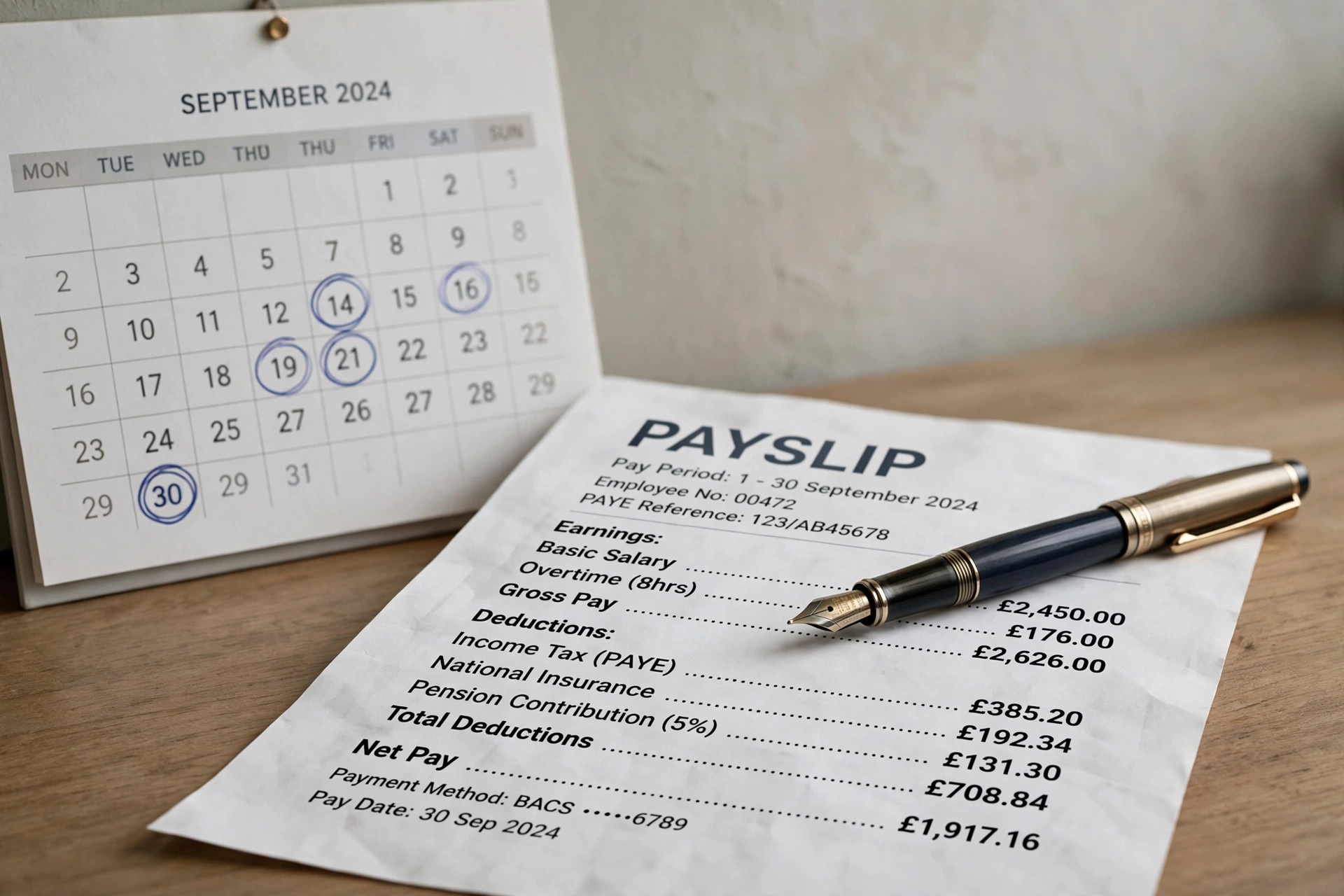
How to Check a Partial-Month Payslip
When the payslip lands, do not just check the total — check the maths behind it:
- Find the day count. Some payslips show “pro rata: 17/31 days” or a similar note. If yours does not, ask payroll for the dates they counted — inclusive or exclusive of your start date changes the result by a full day.
- Reproduce the daily rate. Divide your monthly salary by the month’s day total and compare with the implied rate on the slip.
- Check the month length. Starting on 15 February (28 days) pays noticeably more per day than starting on 15 March (31 days). Make sure payroll used the right month.
- Look for the method. If the figure matches neither the calendar-day nor the working-day result, ask which basis was used — mistakes in partial months are common because they are calculated manually more often than standard runs.
- Confirm tax treatment. A smaller-than-usual payment may push you into a lower tax band for that month under PAYE’s cumulative system; any over-deduction usually corrects itself in later months, but flag anything that looks far off.
If the number is wrong, raise it with payroll promptly and in writing — partial-month errors are easiest to fix in the same tax month.
Partial Month Pay: Frequently Asked Questions
Is partial-month pay calculated on working days or calendar days?
It depends on the employer. The calendar-day method (monthly salary ÷ days in the month) is the most common for monthly-paid staff; some employers use working days (annual salary ÷ 260). Your contract or staff handbook should state which applies — if it does not, ask payroll before disputing the figure.
Do I get paid for weekends in a partial month?
Under the calendar-day method, yes — in effect. Your monthly salary is spread across every calendar day, so the daily rate is lower but weekends count. Under the working-day method, weekends never count at all. Neither method pays you “extra” for weekends; they just slice the same salary differently.
What if I start on the 1st — is that a partial month?
No. Starting on the 1st and working through month-end is a full month, paid at the full monthly rate. The partial-month calculation only kicks in when your paid period starts after the 1st or ends before the last day.
How is a partial month handled in a leap year?
Only February is affected: it has 29 days instead of 28, so the calendar-day daily rate is slightly lower (£2,500 ÷ 29 = £86.21 instead of £89.29). The working-day method is unaffected. Annual day-count methods use 366 as the divisor in a leap year.
Can my employer round the figure?
Minor rounding to the nearest penny is normal and expected. Rounding to whole pounds in the employer’s favour, applied consistently, could amount to an unlawful deduction over time — but a few pence either way on a single payslip is standard payroll practice.
Does a partial month affect my holiday entitlement?
Your holiday accrues pro rata too: for the partial month you accrue roughly one-twelfth of your annual entitlement, sometimes adjusted for the exact days worked. Bank holidays falling in your unpaid days are not owed to you.
Other date-based calculations: joining mid-month · leaving mid-month · start and end dates · days worked · daily rate · starting mid-year · notice pay · redundancy pay
Work It Out in Seconds
Doing this by hand is fine for a one-off check, but the fractions get fiddly — especially with part-time hours layered on top, or a month split across two pay rates. Run your own figures through the free pro rata salary calculator on our homepage: enter your full-time salary and your actual working pattern, and it will show your exact pro rata pay for any partial month, with the working laid out so you can compare it against your payslip.